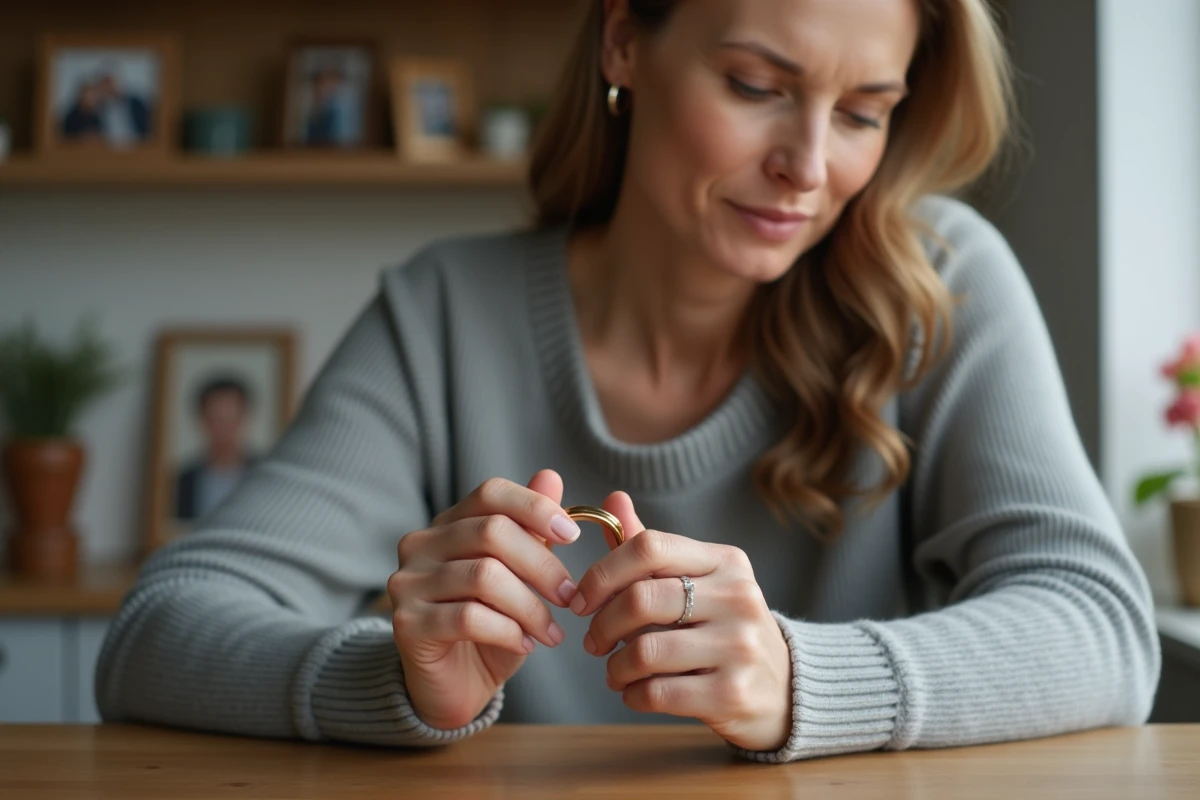
Since the 19th century, the passing of a ring after a death has been accompanied by codified practices, but rarely uniform across families. Offering or wearing this inherited ring often sparks debates, balancing respect for the deceased’s wishes with the search for comfort for the living.
From religious traditions to intimate choices, customs vary, sometimes contradicting official prescriptions. Collected testimonies reveal complex motivations where memory, attachment, and reconstruction intertwine with the symbolism of the jewel.
The Deep Symbolism of Inherited Rings: Between Memory and Transmission
To be part of the continuity of a family story: wearing the ring of a deceased loved one means keeping an inheritance alive while giving new weight to the object. This ring, much more than a simple band, concentrates the memories of an entire lineage and absorbs the values, feelings, and experiences of those who wore it. It is no surprise, then, to see the custom evolving according to families: the ring sometimes shifts from the left hand to the right, depending on the story each wishes to continue writing.
The choice of purple, a color traditionally associated with mourning, sometimes punctuates the ceremony or accessories. This discreet nod highlights absence while paying tribute to it. The ring itself is never fixed: suspended on a chain, inserted into a bracelet, slipped into a locket, it circulates and transforms according to desires, without losing its power to connect the intimate to the memory.
Some prioritize ritual gestures: immersion in water or salt to mark the passage, respecting family or personal beliefs. Wearing the deceased’s ring affirms a place for the departed, whether in daily gestures or during significant moments. Sometimes, the ring thus inherits a true transition ritual where it accompanies a new chapter of life.
The inherited jewel is not just a memory object. It becomes the physical proof of a love story or lineage, a way to anchor the solidarity of generations, even when emptiness settles in. This discreet thread holds firm, reassuring, while adapting to each individual.
What Choices Are Available for Those Who Wish to Wear the Ring of a Deceased Loved One?
The way to appropriate this ring varies widely from person to person. Often, after a death, the ring shifts from the left hand to the right, a gesture that is both modest and meaningful. This change reflects respect for a bond that transcends absence, while signifying entry into a new time.
Many entrust their ring to an artisan to shape it into a pendant, a bracelet, a brooch, or a locket: a transformed jewel that accompanies closely without being ostentatious. Others prefer to store it in a box or pass it on to a child, thus perpetuating family memory.
To better understand the diversity of these adaptations, here are the common paths found:
- Wearing the ring on the left or right ring finger, depending on the personal symbolism attached to the gesture
- Transforming it into a pendant, bracelet, brooch, or locket to keep it close
- Keeping the jewel in a box or a ring holder, as a silent testimony of the past
- Passing the ring to children or a family member, thus perpetuating a collective memory
- Resorting to purification: a bath in water or salt, according to beliefs and traditions, to accompany the transition
Some even go so far as to associate the deceased’s ring with other family pieces: a maternal engagement ring, a grandparent’s locket… The combination creates a new jewel, a witness to a lineage and intertwined stories. During ceremonies, a embroidered object, a souvenir photograph, or a precious detail can also join this ritual, adding a strong personal dimension. No matter the choice, the transmitted ring remains a discreet witness between two worlds, both a marker and a bridge, never silent.

Words and Stories: How These Jewels Accompany Grief in Daily Life
Wearing an inherited ring is never straightforward. This loaded gesture enters daily life as much as it does the heart of emotions. The testimonies speak for themselves: the ring takes on a new role, as a silent support, a guardian of attachment through the days.
The case of Fran Bukrey, for example, illustrates this symbolic strength: she carefully keeps her deceased husband’s ring around her neck. This jewel slips into her daily life, serving as a point of support. But the story takes a twist: over the months, she realizes, thanks to an engraved detail, an attentive jeweler, and a compassionate caregiver, that she was wearing the wrong ring, inadvertently switched during hospitalization. The real one finally finds its place, further proof of the powerful bond that connects memory to the object.
Others choose transformation, transmission, sometimes a purification ritual. Each time, the ring serves as an amulet or anchor, reinforcing the feeling of a silent dialogue with the departed person. In many families, these rings become landmarks, asserting themselves as true markers of stories and attachment. They express a deep attachment, a tangible proof that love or presence does not disappear with loss.
Nothing equals the discreet light of an inherited ring. For some, just feeling it under their fingers or resting against their chest is enough to keep the memory alive, and perhaps gently soothe the lingering absence.