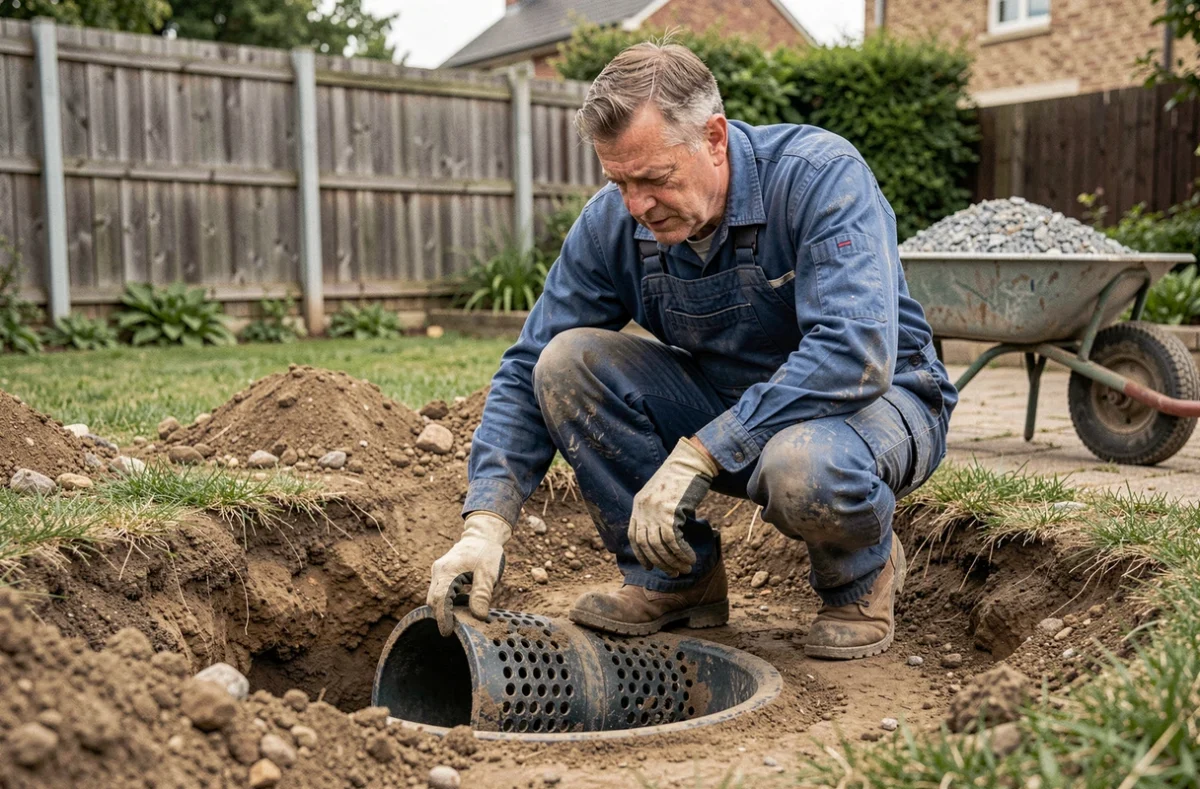
The dry well, or infiltration well, is a structure designed to evacuate rainwater by gradually returning it to the soil. In France, its use is strictly regulated: it only concerns rainwater, not domestic wastewater, even if treated, unless an exceptional exemption is granted by the municipality after a hydrogeological study. The regulatory framework largely depends on local urban planning documents, rain zoning, and the sanitation regulations of each community.
Infiltration and soil: what the terrain imposes before any technical choice
Before considering the installation of a dry well, the nature of the soil serves as the first filter of feasibility. A clayey terrain, for example, absorbs water very slowly and can render the structure ineffective, even counterproductive by creating areas of underground stagnation.
The permeability of the soil is measured by a percolation test conducted on the plot. This test determines the rate at which water infiltrates into the natural ground. Without this data, sizing an infiltration well amounts to working blindly.
The depth of the water table also comes into play. If the water table is too close to the surface, the water injected into the well has nowhere to go, and the risk of contaminating groundwater increases. A preliminary soil study helps identify these constraints, and several communities require it before issuing a permit.
For owners who wish to explore the concrete benefits of this type of structure on their plot, it is possible to learn more on Architop, which details the situations where infiltration at the plot provides a real gain.
Local regulation of the dry well: why standard distances do not exist
On many sites, it is stated that the dry well must be located five meters from a dwelling and thirty meters from a drinking water well. These figures circulate as national standards. The available legal analysis indicates that they are not found in the national texts applicable to any soakaway.
The actual distances depend on local regulations. The PLU (local urban planning plan), rain zoning, or the sanitation regulations of the municipality set their own requirements. Thus, two neighboring plots in different municipalities may be subject to distinct siting rules.
Before starting work, the approach that protects the owner is to consult the urban planning department of the town hall. This point is rarely emphasized, but it conditions the compliance of the project. A technically feasible well on permeable land may be prohibited by municipal regulations or subject to retention volume obligations that the structure alone does not meet.
Management of rainwater at the plot: what the dry well resolves and what it does not
When the terrain and regulations allow, the dry well fulfills a specific function: to evacuate rainwater without discharging it into the collective network. This reduces the load on public sewers, limits the risk of saturation in case of heavy rains, and contributes to the recharge of groundwater.
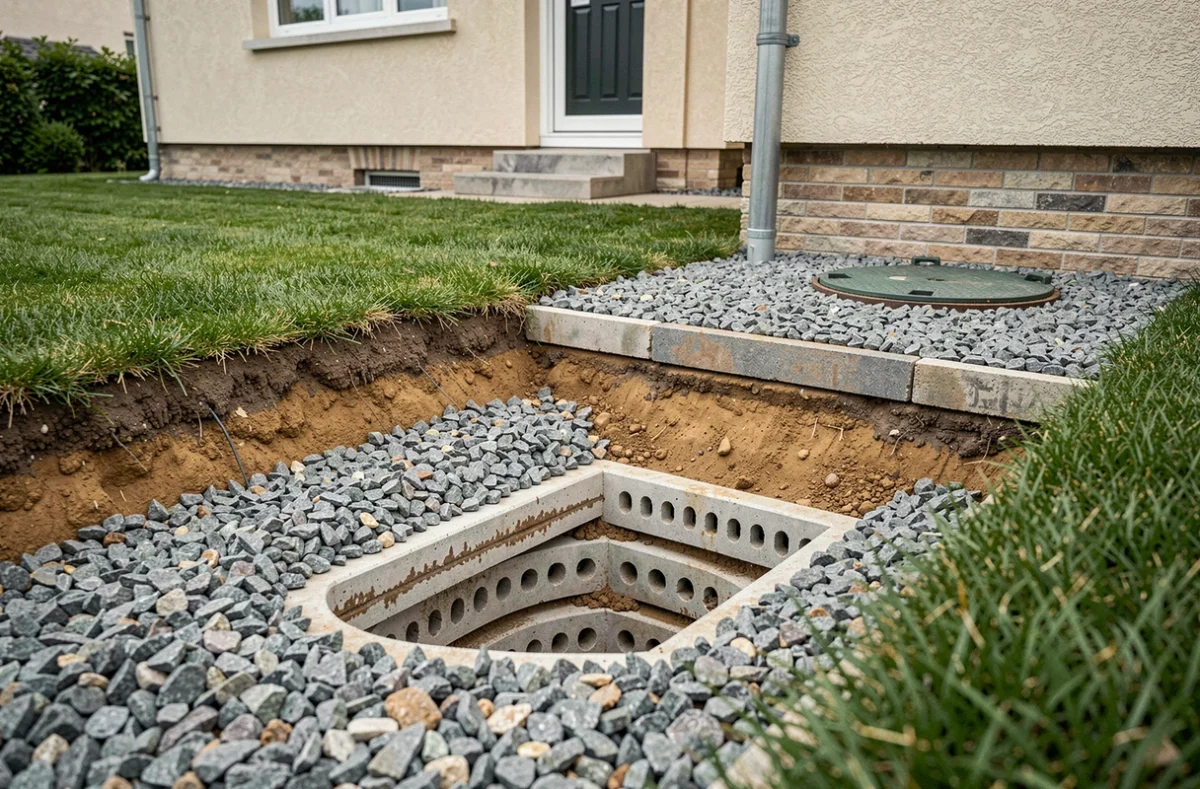
Practically, the structure collects water from gutters, surface drains, or inspection chambers, temporarily stores it in a volume filled with draining materials (gravel, pebbles), and then allows it to infiltrate by gravity into the surrounding soil.
What the dry well concretely provides
- Reduction of surface runoff on the plot, which limits soil erosion and persistent puddles after a rainy episode
- Progressive feeding of the local groundwater table, a measurable environmental benefit on well-permeable lands
- Autonomy from the public rainwater drainage network, which can represent an advantage in areas where this network is non-existent or undersized
- Generally moderate installation cost compared to other retention systems (tanks, buried retention basins)
What it does not cover
The dry well does not treat domestic wastewater. Discharging wastewater into a soakaway is prohibited in France, except under a regulated and exceptional exemption. Confusing rainwater and wastewater in the design of an evacuation system exposes one to sanctions and a refusal of compliance during sanitation control.
Moreover, the structure alone does not guarantee regulatory compliance. Rain zoning may impose retention volumes greater than what a standard infiltration well can absorb. In this case, the well must be coupled with other devices (swales, drainage trenches, retention tanks).

Maintenance of the dry well: signs of dysfunction to watch for
An infiltration well operates by gravity and the porosity of the soil. Without maintenance, the filtering materials gradually clog. Leaves, fine sand, and organic deposits reduce the absorption capacity until the structure becomes inoperative.
Several indicators signal a saturated or clogged well:
- Water rises to the surface around the structure after moderate rain, whereas it previously drained without issue
- Odors appear near the access chamber, a sign of prolonged stagnation
- The visible water level in the well no longer decreases in the hours following a rainy episode
Maintenance involves cleaning the chamber, removing accumulated deposits, and checking the condition of the draining materials. On clay-rich terrain, clogging can occur in just a few years. On sandy soil, the structure may function much longer without intervention.
The lack of maintenance does not only lead to a loss of performance. A saturated dry well that overflows into a neighbor’s property can engage the owner’s liability, a legal aspect documented in case law related to neighborhood disturbances linked to rainwater.
The dry well remains a simple structure in principle, but its relevance entirely depends on the soil, local regulatory framework, and ongoing monitoring over time. Checking these three parameters before digging avoids unpleasant surprises, both technical and legal.